By Drake Miller – Senior Content Manager and Academic Strategy Consultant
The Australian educational landscape has undergone a seismic shift. As we navigate 2026, the traditional “grind” is being replaced by high-efficiency, tech-integrated learning. Whether you are tackling the HSC in Sydney, the VCE in Melbourne, or pursuing a Bachelor’s degree at a Group of Eight university in Brisbane or Perth, the pressure to perform has never been higher.
However, high performance doesn’t require more hours; it requires better strategy. In an era of AI-driven classrooms and hybrid learning models, “studying harder” is a recipe for burnout. To succeed, you must study smarter. Many students now balance their workload by utilizing professional assignment services Australia to manage complex projects while focusing on core exam preparation.
This guide explores the most effective, science-backed study techniques tailored for the Australian student in 2026.
1. The 2026 Tech Stack: Leveraging AI Responsibly
By 2026, Artificial Intelligence is no longer a novelty; it is a core component of the Australian curriculum. From the ATAR system to postgraduate research, the key is using AI as a tutor, not a ghostwriter.
- Socratic AI Interaction: Instead of asking AI to write your essay, use it to poke holes in your argument. Feed your thesis statement into a generative tool and ask, “What are the counter-arguments to this based on the current Australian economic climate?” For students needing more localized, human-led guidance on refining these arguments, seeking assignment help Brisbane can provide that necessary expert oversight to ensure academic standards are met.
- Personalised Flashcard Generation: Tools now allow you to upload your lecture recordings or PDFs to automatically generate Anki or Quizlet decks. This saves hours of manual data entry, allowing you to move straight to active recall.
- Digital Wellbeing Integration: With the 2024–2025 “Right to Disconnect” culture influencing even student life, 2026 students are using focus apps that sync across Apple Vision Pro, laptops, and phones to create “distraction-free zones” during peak study hours.
2. Active Recall and Spaced Repetition: The Gold Standard
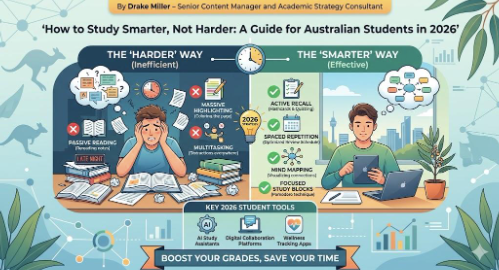
If you are still re-reading highlighted textbooks, you are using a technique that science has repeatedly proven to be inefficient. For the high-stakes environment of Australian exams, you need two core pillars: Active Recall and Spaced Repetition.
- Active Recall: Active recall involves closing the book and forcing your brain to retrieve information. Instead of reading about the Mabo v Queensland case, write down everything you remember about the legal implications first, then check the text for what you missed. This “effortful retrieval” strengthens neural pathways.
- Spaced Repetition: The “forgetting curve” shows that we lose 50% of new information within 24 hours unless we review it. Use the “1-3-7-30” rule. Review your notes 1 day after the lecture, then 3 days later, then a week later, and finally a month later.
3. The “State of Flow” and the Pomodoro 2.0
In 2026, the 25-minute Pomodoro technique evolved. Many Australian high achievers now use “Flow-time.”
Instead of a rigid timer, work until you feel your focus wavering, then take a break proportional to the work done. To reach this state, your environment must be “curated.” Australia’s leading universities now offer “Bio-Sync” study hubs—replicate this at home by using warm lighting in the evening and natural blue light in the morning.
4. Adapting to the Australian Assessment Model
The Australian tertiary and secondary sectors have moved toward “Authentic Assessment.” This means fewer multiple-choice exams and more case studies, portfolios, and oral presentations.
- For High Schoolers (Year 11 & 12): Focus on the syllabus dot points. The VCAA and NESA curriculums are transparent. Your goal shouldn’t be to know “everything”; it should be to answer every specific dot point in the syllabus.
- For University Students: Academic integrity is strictly monitored via advanced metadata analysis. If you find yourself struggling with a massive workload, seeking guidance is essential. Many students look for professional assignment help for Australian students to understand complex rubrics and structure their research papers correctly, ensuring they meet the high standards of Australian academic writing.
5. The “Feynman Technique” for Complex Concepts
Australia’s STEM and Law degrees are notoriously rigorous. When you hit a wall with a concept like “Quantum Entanglement” or “Equity and Trusts,” use the Feynman Technique:
- Choose a concept.
- Pretend to teach it to a 10-year-old.
- Identify the gaps in your explanation.
- Review the source material and refine.
6. Nutritious Fuel: The “Brain Food” Advantage
With Australia’s focus on holistic health in 2026, students are moving toward “Cognitive Nutrition.”
- Omega-3s: Essential for brain health. Think Tasmanian Salmon or chia seeds.
- Low GI Carbohydrates: Swap white bread for Australian oats or quinoa to avoid the “study slump.”
- Hydration: The Australian climate, especially in QLD and WA, can lead to mild dehydration, which reduces concentration by up to 20%.
7. Collaborative Learning in the Hybrid Era
Isolation is the enemy of motivation. In 2026, “Study With Me” virtual rooms and Discord study servers are the norm. Joining a study group—whether at the University of Sydney library or a private Discord for Year 12 Physics—allows for “Peer-to-Peer Teaching,” which is the highest form of mastery.
8. Managing ATAR and GPA Anxiety
Mental health is a critical component of studying smarter. Australia has seen a shift toward “Mindful Productivity.”
- NSDR (Non-Sleep Deep Rest): 20-minute protocols are being used by students to “reset” their nervous systems between intense study blocks.
- The Power of “No”: Smarter students prioritize their “Big Three” tasks for the day and stop once they are completed.
9. Leveraging Professional Support
Sometimes, despite your best efforts, the volume of work becomes overwhelming. In the competitive Australian market, maintaining a high GPA or ATAR is vital for future career prospects.
It is okay to ask for help. Whether it’s through university-provided tutoring or utilizing academic writing support for high schoolers, getting a second pair of eyes on your work can provide the clarity needed to turn a Credit into a High Distinction.
10. The Night Before: The Final Strategy
In 2026, we know that sleep is a cognitive necessity. Sleep is when your brain “consolidates” the day’s learning. Pulling an all-nighter at the State Library might feel productive, but it actually lowers your IQ for the following day. Aim for 7–9 hours of sleep.
Conclusion: Your 2026 Roadmap
Studying smarter in Australia today is about being an architect of your own education. It’s about using AI to sharpen your mind, using active recall to cement your knowledge, and using professional support when the path gets steep. By focusing on efficiency over exhaustion, you won’t just get the grades—you’ll actually remember what you learned long after graduation.
Frequently Asked Questions
Q.1 What is the most effective study technique for the HSC and VCE in 2026?
While many techniques exist, Active Recall and Spaced Repetition remain the gold standard. For Australian students, this means moving away from passive reading and toward effortful retrieval based on specific NESA or VCAA syllabus dot points.
See also: Smart Ways to Enjoy Premium Flights to India Without Overspending
Q.2 How can I use AI for my assignments without breaching academic integrity?
In 2026, the key is using AI as a “Co-Pilot” rather than a “Ghostwriter.” Use generative tools to brainstorm structures, find counter-arguments, or explain complex theories. Always ensure your final submission reflects your own analysis and meets the specific metadata requirements of your institution.
Q.3 Is it okay to use professional assignment help in Australia?
Yes, seeking external support is a common strategy for high-achieving students managing heavy workloads. Utilizing professional assignment help services allows you to understand complex marking rubrics and improve your academic writing style, which is essential for maintaining a high GPA or ATAR.
Q.4 How do I balance study with the “Right to Disconnect” culture?
Modern students use “Digital Wellbeing” tools to sync focus modes across their devices. By setting strict study blocks and using NSDR (Non-Sleep Deep Rest) protocols, you can maintain high productivity during the day so that you can fully disconnect in the evenings without guilt.
About the Author
Drake Miller is a senior content manager and academic strategy consultant with over 12 years of experience in the higher education sector. Based in London and Sydney, Drake specializes in the ethical integration of Agentic AI and digital literacy into student workflows. He is a passionate advocate for academic integrity and helping students navigate the complexities of modern educational technology to achieve peak academic performance.